
India’s Exceptional GDP Growth — Explained
Posted On : Thu Dec 11 2025
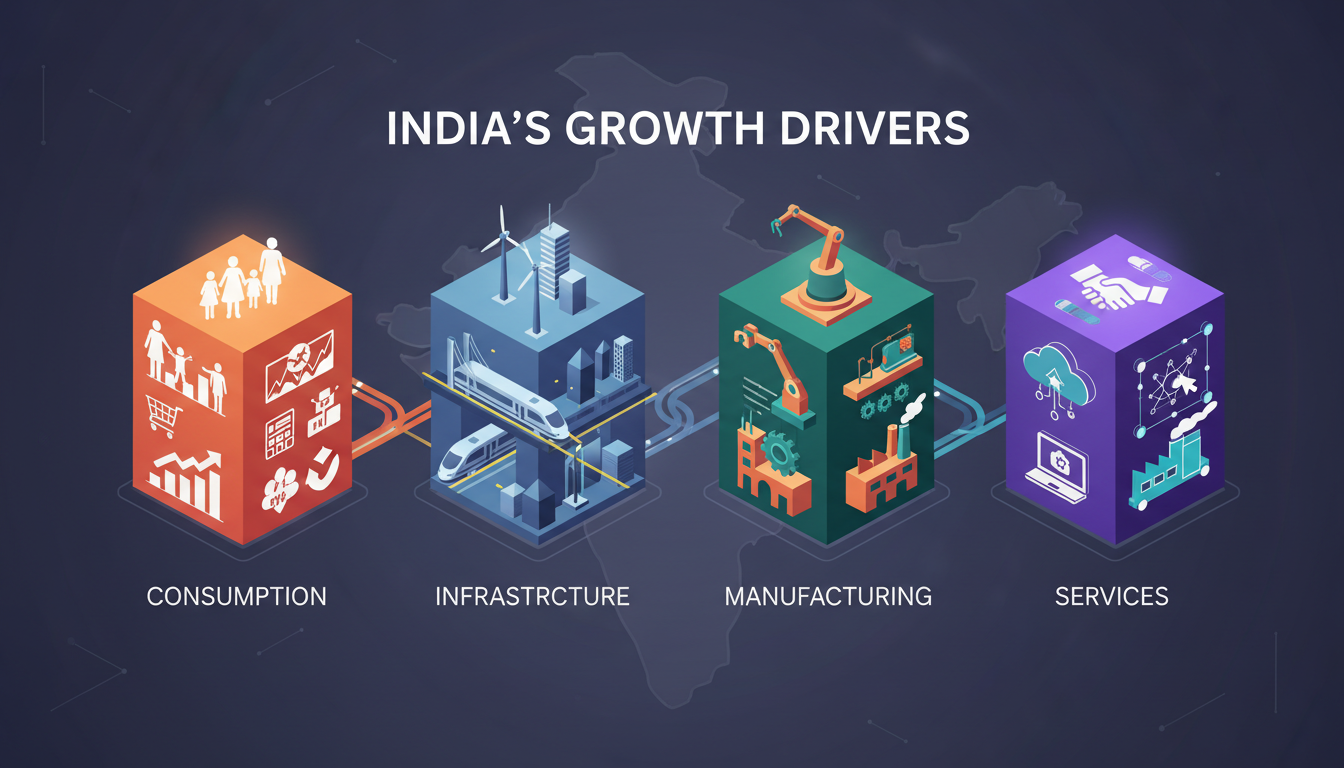
Figure: India’s Growth Drivers
India Continues to Shine as a Fast-Growing Global Economy
India has demonstrated remarkable economic resilience, recording a six-quarter high GDP growth of 8.2% in the July–September quarter of FY 2025–26. Both the Reserve Bank of India (RBI) and Fitch Ratings have raised India’s growth outlook, projecting GDP expansion of 7.3% to 7.4% for FY 2025–26 and FY 2026.
This growth trajectory strengthens India’s position to become the fourth-largest economy globally by FY 2025–26, overtaking Japan.
What’s Fueling India’s Strong Economic Performance?
1. Domestic Consumption
Nearly 70% of India's GDP is driven by private domestic consumption — making it the world’s third-largest consumer market.
Growth is being reinforced by:
- Tax cuts improving disposable income
- GST rationalization lowering inflationary pressure
- Seasonal and festival-led spending boosting short-term consumption cycles
Robust household demand continues to act as India’s backbone for sustained economic activity.
2. Government Capital Expenditure
India’s government has aggressively ramped up capital expenditure, with large-scale investments in:
- Road and highway expansion
- Railway modernization
- Green energy and renewables
- Ports and logistics corridors
This front-loading of infrastructure spending creates a multiplier effect, spurring job creation and stimulating private investment.
3. Improving Private Investment Outlook
As interest rates stabilize and financial conditions ease, private sector investment is expected to accelerate, particularly in:
- Manufacturing
- Digital infrastructure
- Emerging technologies
4. Services Sector
Accounting for more than 60% of India’s GDP, the services sector — including IT, trade, finance, and public administration — remains the country’s biggest engine of growth.
5. Manufacturing Momentum
Government PLI schemes, Make in India policies, and global supply chain diversification are strengthening domestic manufacturing competitiveness.
6. Demographic Dividend
With a median age of 28 years, India has one of the youngest workforces globally — a major long-term economic advantage.
Structural Challenges India Must Address
Despite outstanding headline numbers, certain deep-rooted challenges must be solved to ensure long-term, inclusive, and sustainable growth.
1. Job Creation & Quality of Employment
- Youth unemployment remains a major concern.
- While GDP is rising, quality job creation is not keeping pace, indicating the need for labour-intensive growth and skill-focused reforms.
2. Infrastructure Gaps
India requires major improvements in:
- Transportation networks
- Power systems
- Urban infrastructure
- Digital connectivity
Better infrastructure will improve competitiveness and lower logistics costs across sectors.
3. Persistent Poverty & Income Inequality
Despite rapid economic growth, large segments of the population still live below the poverty line. Income inequality also remains high, signaling the need for more inclusive growth outcomes.
4. Data Quality Concerns
The IMF has highlighted that India’s GDP continues to be calculated using an outdated base year (2011–12). The government plans to transition to a 2022–23 base year, improving data reliability and international confidence.
5. Climate Vulnerability
Rising temperatures, extreme weather, and water scarcity pose significant risks—especially for agriculture, which supports millions of households.
🌟 Why India’s GDP Story Remains a Global Bright Spot
India’s combination of:
- A strong domestic market
- Improving governance
- Rapid digitization
- Large-scale infrastructure expansion
- Demographic strength
makes it one of the most promising growth markets in the world. Despite structural issues, India’s long-term economic trajectory remains extremely compelling.
Waya’s View: The Best Is Yet to Come
At Waya Financial Technologies, we remain bullish on India’s capital markets, consumption story, and economic transformation.
With reforms accelerating and growth engines strengthening, India is only at the beginning of a multi-year expansion cycle.
Regards
Amit Vora, CEO